Applied Science
| Title | On Geochemical survey for assessing gas seepage in Deohal area |
|---|---|
| Participants | D. J. Patil, A.M. Dayal, M.S. Kalpana, T. Madhavi, Devleena Mani, M. Lakshmi, M. A. Rasheed, P.L. Srinivas Rao, S. Kavitha, Snigdharani Mishra, N Pundaree |
| Sponsoring Agency | Oil India Limited |
Work Description:
Oil India Limited awarded a contract for geochemical survey for assessing the gas seepage in Deohal area from blowout well NHK # 285, using gas concentration, microbiology and isotopic signature on 14.12.1012. NHK#285 well was drilled in 1976 to target depth of 3913m within basement. It was the first exploration well on Deohal structure for probing hydrocarbon prospects. It was producing 20,000-30,000 SCMD of gas from 2427m Barail sand through 3.0m bean till July 2011. On 14th July 2011 a high intensity sound from the well was reported and gas leakage was observed at various places of the wellhead. Subsequently the well was abandoned. Basic objective of the study was to see the extent of spread of blowout gas around the well in an area of 70 sq km by studying the subsurface soil samples for light hydrocarbon concentration as well as the microbial study. A total of 208 soil core samples were collected around the blowout area. For the realization of above-mentioned objectives, the following work elements have been used:
Determination of concentration of light gaseous (Methane (C1), Ethane (C2), Propane (C3), i-Butane (iC4), n-Butane (nC4), i-Pentane (iC5) and n-Pentane (nC5)) hydrocarbons in soil samples using Gas chromatograph (GC).
Measurement of carbon isotopic ratio for TM13C in selected soil samples using Gas Chromatography-Combustion-Isotope Ratio Mass Spectrometer (GC-C-IRMS).
Microbial study of Propane and Ethane Oxidizing Bacteria (POB, EOB) in soil samples. Integration of Gas Chromatographic, Carbon isotopic and Microbial data sets to in order to delineate prospect regions.
The adsorbed soil gas analyses show presence of moderate to low concentrations of methane in the study area. Ethane, propane and butane have not been detected in any of the sample. The pattern of distribution of light hydrocarbon gases and microbial data in the study area shows low concentration as we move away from the well.
Ethane and propane were not detected in adsorbed gas analysis but EOB and POB were found in all the samples. The concentration map of POB indicates presence of higher values around the well and towards the south of the well. EOB also shows higher counts around the well, south of the well and northeast of well.
Integrated map of methane concentration, POB and EOB show higher concentrations around the well # 285, disperse higher concentrations towards north and south of well (Fig 13.1). These higher concentrations may be associated with some fault systems in the area.
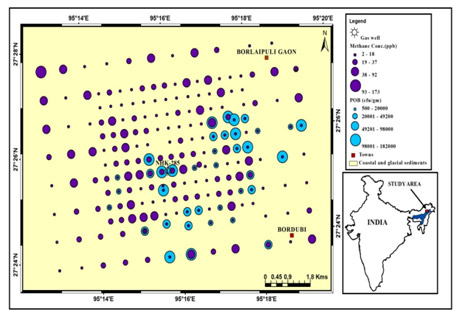
Fig.13.1:
POB anomaly map