Applied Science
| Title | HYDROGEOLOGICAL DATA GENERATION FOR MAPPING THE GROUND WATER REGIME, NFC CAMPUS, HYDERABAD - SSP-636-28(RR) |
|---|---|
| Participants | R. Rangarajan, G.B.K. Shankar, Kamle Anand, V. Venkatesam, . K. Rajeshwar, . Rama Devi, . D. Muralidharan, . A. Mohan Reddy |
| Sponsoring Agency | NFC, Hyderabad |
Work Description:
Integrated scientific studies comprising hydrological & hydrogeological monitoring, geophysical, geochemical and tracer experiments were carried out within NFC main campus and adjacent Solar Evaporation Pond (SEP) areas for knowing subsurface geology, understanding prevailing hydrogeolgical conditions, recharge rate and ground water flow dynamics and the cause of groundwater pollution.
The important observations / findings / conclusions based on the project study are;
The scale of resistivity values obtained from resistivity sounding survey and through litho logs of bore holes drilled up to the maximum depth of 48 m in NFC main campus and solar evaporation pond area (waste disposal site) indicate occurrence of thick weathered to semi weathered zones followed by one or more fracture zones of 3-5 feet thickness within the depth zone of 30 m. The approximate yield of the wells in NFC site range from 121 – 671 gph. Groundwater flow maps of NFC main campus indicate the flow pattern is from north and northwest to south and southeastern side coinciding with drainage pattern (
Fig. 8.1). In SEP area, the groundwater flow pattern is complicated. In the northern part, the movement is from northwest to south and east and in the southern part, it is from east to west, southwest and south. A marked water divide is observed in the middle part of the area in W-E direction with significance on east-central part (
Fig.8. 2).Natural recharge study using tritium injection technique indicates moderate to high recharge during 2012 monsoon. Average rainfall recharge of 146.8 mm was estimated from tritium profiles for 2012 monsoon (
Fig. 8.3). High recharge is due to several moderate rainfall events of 40-60 mm/d, high intensity rainfall event of 140 mm/d during 2012 monsoon and favorable soil conditions. Aquifer parameters determined by pumping tests at newly drilled NGRI wells yielded Transmissivity in the range of 12.5 to 275 m2/d and Storage Coefficient in the range of 2.0x10⁻³ to 5x10⁻⁴. The actual velocity of groundwater flow at selected sites is calculated under different effective porosity conditions of the aquifer formation (6-10 %). The calculated values indicate that velocity of groundwater flow varies from 3.39 - 10.64 m/d in northern part and 1.26 - 1.72 m/d in the southern part. It can be considered that the flow rate measured in the northern part is under induced condition and the flow in the southern part is under natural flow condition. The results of the tracer study conducted at newly drilled bore wells have helped in identifying the pollution plume pathway within the NFC complex area. The analytical data of groundwater samples collected from newly drilled bore wells in NFC main campus and SEP area indicates that in most of the cases, the Total Dissolved Solids and concentrations of ions are within / slightly above the permissible limit of drinking water. The trace element analysis also shows that the concentrations of most of the elements are within the permissible limit for drinking water. Integrated geohydrological investigation enabled in deciphering the shallow aquifer system in NFC campus and waste disposal areas.
The findings helped the NFC authorities to formulate suitable strategies in controlling the anticipated contamination due to their activities within their active area.
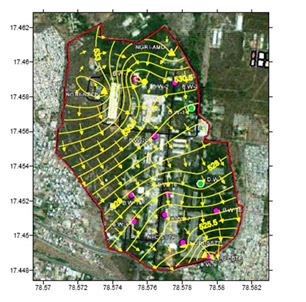
Fig.8.1:
Groundwater flow map in NFC main campus
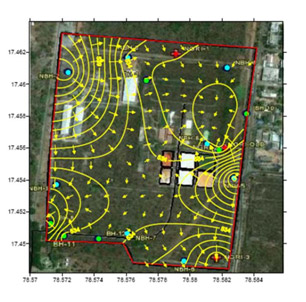
Fig.8.2:
Groundwater flow map in solar evaporation pond
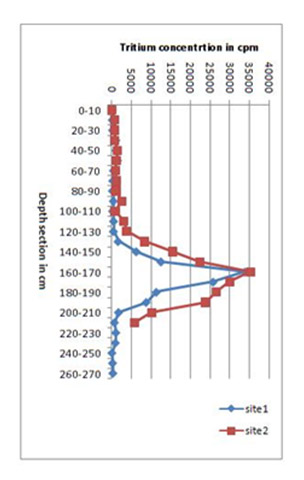
Fig.8.3:
Tritium profiles at natural recharge sites