Basic Science
| Title | Late Quaternary paleoclimatic & paleoceanographic studies using isotopic and trace elemental proxies from ocean sediments, corals and speleothems |
|---|---|
| Participants | Syed Masood Ahmad; Netramani Sagar; K. Venkatesham; Waseem Raza; G. Suseela; Mahjoor A. Lone; Shilpa Vuba; Tabish Raza; Sadia Farnaaz |
| Sponsoring Agency | CSIR- NGRI |
Work Description:
Speleothem δ18O based high-resolution record of Indian summer monsoon (ISM) variability during the last deglaciation
A high-resolution record of Indian summer monsoon (ISM) variability during the last deglaciation has been generated using δ18O values from a cave deposit (speleothem - stalagmite), located in the Kurnool district of Andhra Pradesh. This record covers a time span of 1,000 yrs from 15,700 to 14,700 yr BP with an average sampling resolution of ~5 yrs. High amplitude δ18O variations in this record suggest abrupt changes in ISM activity during the last deglaciation (Figure-31.1) and reveal the possible onset timing of Termination 1a at ~14,800 in Indian region 12:16:39 which is generally characterized by a major climate transition. Coincident variability in VSPM4 δ18O record with speleothems from southern China suggests that the Chinese caves also reflect fluctuations in ISM variability. The variance in δ18O amplitude of VSPM4 record reveals significant multidecadal ISM variability. Our record depicts some intense monsoon events during the later phase of Heinrich event (H1) and shows synchronous variability between ISM and East Asian monsoon (EAM). Spectral analysis of our δ18O time series reveals solar forcing and strong ocean-atmospheric circulation control on ISM dynamics during the studied time interval.
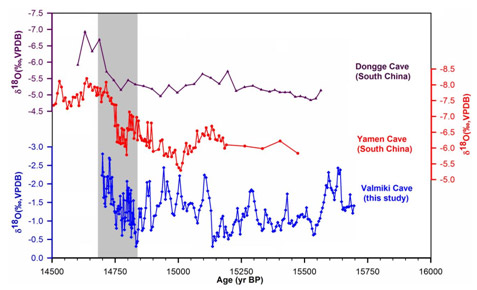
Fig.31.1:
Oxygen isotopic record of stalagmite from a Kurnool cave (Valmiki cave) compared with records from Chinese caves. Depleted del 18O values suggest intensification of monsoon precipitation.
(Mahjoor A. Lone, S. Masood Ahmad, Waseem Raza, K. Venkatesham and G. Suseela)