


Page 13 - CSIR-NGRI_Newsletter_8_8_August_2026-eng
P. 13
CSIR-NGRI Monthly Newsletter Volume 8, issue 08, August 2026

          Research Output


                                 ResearchHighlights


          Maurya VP, Meju MA, Chaves CAM, Fontes SL, Padilha AL, Benevides AS, Rodrigues LN, La Terra EF.
          Lithospheric structure of central Brazil revealed by combined 3-D electromagnetic and seismic
          tomography: relationship to intraplate magmatism and seismicity. GEOPHYSICAL JOURNAL
          INTERNATIONAL. 2026;246(3). doi:10.1093/gji/ggag280.

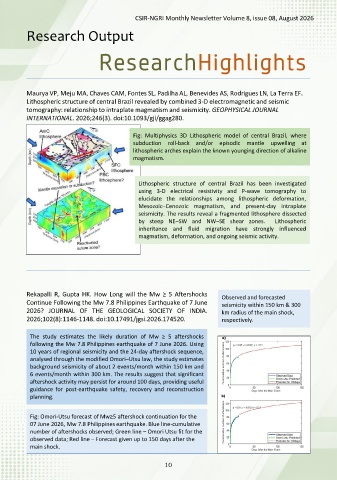
                                            Fig: Multiphysics 3D Lithospheric model of central Brazil, where
                                            subduction  roll-back  and/or  episodic  mantle  upwelling  at
                                            lithospheric arches explain the known younging direction of alkaline
                                            magmatism.


                                             Lithospheric structure of central Brazil has been investigated
                                             using 3-D electrical resistivity and P-wave tomography to
                                             elucidate the relationships among lithospheric deformation,
                                             Mesozoic–Cenozoic magmatism, and present-day intraplate
                                             seismicity. The results reveal a fragmented lithosphere dissected
                                             by steep NE–SW and NW–SE shear zones.       Lithospheric
                                             inheritance and fluid migration have strongly influenced
                                             magmatism, deformation, and ongoing seismic activity.


          Rekapalli R, Gupta HK. How Long will the Mw ≥ 5 Aftershocks
                                                                        Observed and forecasted
          Continue Following the Mw 7.8 Philippines Earthquake of 7 June  seismicity within 150 km & 300
          2026? JOURNAL OF THE GEOLOGICAL SOCIETY OF INDIA.             km radius of the main shock,
          2026;102(8):1146-1148. doi:10.17491/jgsi.2026.174520.         respectively.

           The study estimates the likely duration of Mw ≥ 5 aftershocks
           following the Mw 7.8 Philippines earthquake of 7 June 2026. Using
           10 years of regional seismicity and the 24-day aftershock sequence,
           analysed through the modified Omori–Utsu law, the study estimates
           background seismicity of about 2 events/month within 150 km and
           6 events/month within 300 km. The results suggest that significant
           aftershock activity may persist for around 100 days, providing useful
           guidance for post-earthquake safety, recovery and reconstruction
           planning.


           Fig: Omori-Utsu forecast of Mw≥5 aftershock continuation for the
           07 June 2026, Mw 7.8 Philippines earthquake. Blue line-cumulative
           number of aftershocks observed; Green line – Omori Utsu fit for the
           observed data; Red line – Forecast given up to 150 days after the
           main shock.


                                                      10

