


Page 16 - CSIR-NGRI_Newsletter_8_8_August_2026-eng
P. 16
CSIR-NGRI Monthly Newsletter Volume 8, issue 08, August 2026

          Staff Corner

                                                                     Researcher’s

                                                                            Voice


          Earth’s Metal Endowment from


          Precambrian to Present and Beyond


           The Precambrian Eon accounts for 88% of the geological time scale and spans about seven-eighths of
           intriguing Earth’s history. The scientific instinct to unravel the obscured origin of the rocks preserved in the
           Precambrian terranes from various cratonic provinces of the Earth has revealed the manifestation of
           Phanerozoic-type plate tectonic process viz., rifting, subduction, accretion and amalgamation etc. much early
           in the Earth’s evolutionary history. Subduction related magmatic arcs in the Precambrian terranes account for
           nearly two-thirds of global copper and one-third of global gold production. The role of subduction processes
           in ore genesis is well accepted. Arc magmatic rocks contain more economic metallic ore bodies per unit area
           than rocks formed in any other tectonic setting.
                  Copper is one of the first metals ever extracted and used by early humans, and it has made vital
           contribution to sustaining and improving society since the dawn of civilization. Because of its superior
           electrical conductivity, anti-corrosive and antimicrobial properties, it has become an indispensable ware in
           household domestic appliances, electrical and electronic applications, and in the production of EV batteries.
                  The world’s production (supply) and consumption (demand) of copper has increased dramatically in
           the last few decades. As large developing countries have entered the global market, demand for mineral
           commodities, especially copper has increased. Copper consumption in emerging economies, such as China
           and India, rose considerably, compared to the industrialized economies, such as the United States. An off-
           hand appraisal indicates that an average car contains at least 2 km of copper wiring in its various
           components amounting to about 30 kg. With the automotive boom in the rising economy like India, which is
           thoroughly converging towards EV driven automotive market, and super speed rail systems, there will be an
           ever-growing demand for copper. With the existing production of copper in India, the sustenance of the
           supply chain bridging the intense demands will be in a perilous situation. Furthermore, India’s large-scale
           railway electrification project with a massive investment of more than 5 billion USD is targeted to meet 458
           GW peak demand by the end of 2032. Therefore, it is absolutely an important endeavour to discover potential
           ore reserves to ensure a steady and adequate production and supply of copper for a sustainable future.


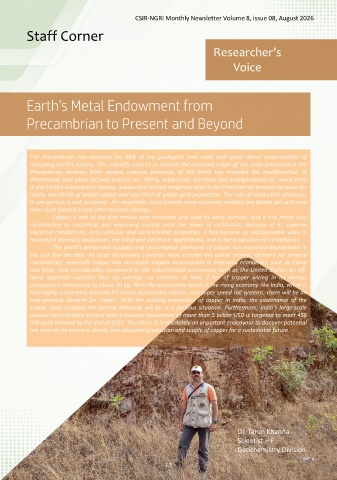
                                                                             Dr. Tarun Khanna
                                                                             Scientist – F
                                                                             Geochemistry Division

                                                      13
                                                      18

