


Page 15 - CSIR-NGRI_Newsletter_8_8_August_2026-eng
P. 15
CSIR-NGRI Monthly Newsletter Volume 8, issue 08, August 2026

          Rao VV, Laxminarayana K, Ranjan P, Mandal B, Karuppannan P, Kumar P. Uplift and seismicity of
          intraplate regions of India: role of rheology, paleo-and active tectonics. FRONTIERS IN EARTH
          SCIENCE. 2026;14. doi:10.3389/feart.2026.1874006.

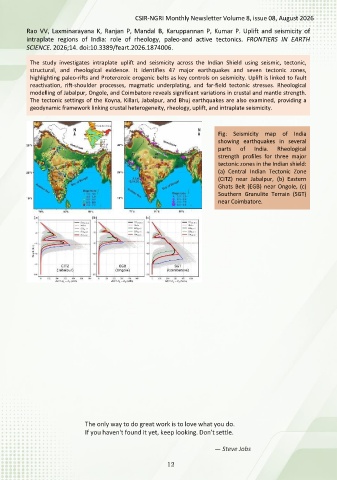
           The study investigates intraplate uplift and seismicity across the Indian Shield using seismic, tectonic,
           structural, and rheological evidence. It identifies 47 major earthquakes and seven tectonic zones,
           highlighting paleo-rifts and Proterozoic orogenic belts as key controls on seismicity. Uplift is linked to fault
           reactivation, rift-shoulder processes, magmatic underplating, and far-field tectonic stresses. Rheological
           modelling of Jabalpur, Ongole, and Coimbatore reveals significant variations in crustal and mantle strength.
           The tectonic settings of the Koyna, Killari, Jabalpur, and Bhuj earthquakes are also examined, providing a
           geodynamic framework linking crustal heterogeneity, rheology, uplift, and intraplate seismicity.


                                                                       Fig:  Seismicity  map  of India
                                                                       showing earthquakes in several
                                                                       parts  of  India.  Rheological
                                                                       strength profiles for three major
                                                                       tectonic zones in the Indian shield:
                                                                       (a) Central Indian Tectonic Zone
                                                                       (CITZ) near Jabalpur, (b) Eastern
                                                                       Ghats Belt (EGB) near Ongole, (c)
                                                                       Southern Granulite Terrain (SGT)
                                                                       near Coimbatore.


                            The only way to do great work is to love what you do.
                            If you haven't found it yet, keep looking. Don't settle.

                                                                      ― Steve Jobs

                                                      12

