


Page 14 - CSIR-NGRI_Newsletter_8_8_August_2026-eng
P. 14
CSIR-NGRI Monthly Newsletter Volume 8, issue 08, August 2026

          Murarishetti S, Kumar VP, Sivaram K, Shekar M, Kumar P. Monitoring hydrologically influenced
          seismic processes in Palghar region using Horizontal-to-Vertical Spectral Ratio (HVSR) analysis.
          JOURNAL OF SEISMOLOGY. 2026;30(4). doi:10.1007/s10950-026-10431-2.


                                             The study examines seasonal changes in shallow subsurface
                                             properties in the Palghar earthquake swarm region of western
                                             India. Earthquake recordings from 6 broadband stations were
                                             analyzed using EHVSR, SSR, and HVSR inversion methods during
                                             pre-monsoon and monsoon/post-monsoon periods. The results
                                             show measurable seasonal changes in resonance frequency,
                                             amplification, shear-wave velocity, and VP/VS ratio, while deeper
                                             structures remain relatively stable. The strongest variations were
                                             observed near the earthquake swarm nucleation zone, indicating
                                             possible hydrological influences.


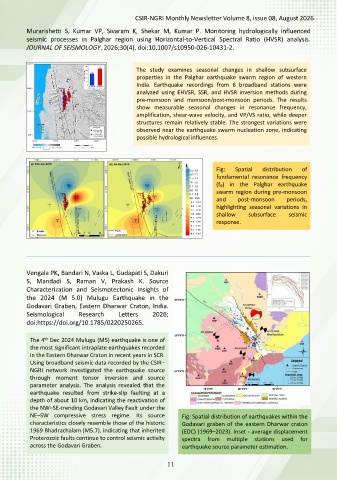
                                                                      Fig:  Spatial  distribution  of
                                                                      fundamental resonance frequency
                                                                      (f₀) in the Palghar earthquake
                                                                      swarm region during pre-monsoon
                                                                      and    post-monsoon    periods,
                                                                      highlighting seasonal variations in
                                                                      shallow   subsurface   seismic
                                                                      response.


          Vengala PK, Bandari N, Vaska L, Gudapati S, Dakuri
          S, Mandadi S, Raman V, Prakash K. Source
          Characterization and Seismotectonic Insights of
          the 2024 (M 5.0) Mulugu Earthquake in the
          Godavari Graben, Eastern Dharwar Craton, India.
          Seismological   Research     Letters    2026;
          doi:https://doi.org/10.1785/0220250265.

               th
           The 4 Dec 2024 Mulugu (M5) earthquake is one of
           the most significant intraplate earthquakes recorded
           in the Eastern Dharwar Craton in recent years in SCR.
           Using broadband seismic data recorded by the CSIR–
           NGRI network investigated the earthquake source
           through moment tensor inversion and source
           parameter analysis. The analysis revealed that the
           earthquake resulted from strike-slip faulting at a
           depth of about 10 km, indicating the reactivation of
           the NW–SE-trending Godavari Valley Fault under the
           NE–SW compressive stress regime. Its source     Fig: Spatial distribution of earthquakes within the
           characteristics closely resemble those of the historic  Godavari graben of the eastern Dharwar craton
           1969 Bhadrachalam (M5.7), indicating that inherited  (EDC) (1969–2023). Inset - average displacement
           Proterozoic faults continue to control seismic activity  spectra  from  multiple  stations  used  for
           across the Godavari Graben.                     earthquake source parameter estimation.


                                                      11

